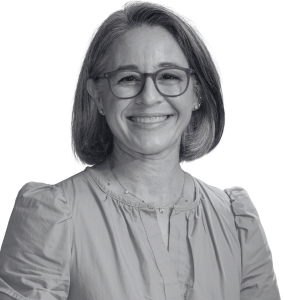
Erika Vogel is The iCenter’s Program Director for the Graduate Degree in Israel Education in partnership with the George Washington University. She holds a B.A. in International and Middle Eastern Studies from Emory University and an M.A. in International Relations from the University of Chicago. With more than 25 years of experience in nonprofit leadership, she brings expertise in policy, the arts, and education. She specializes in building communities and designing academic experiences that inspire connection and growth, guided by her belief that education is a powerful tool for creating a better future.
Meet Erika
When did you join The iCenter, and how has your role evolved over time?
I started at The iCenter in the spring of 2014. Over the years, I’ve had the opportunity to wear many hats: from development to data management to my favorite: Program Director for the Graduate Degree in Israel Education at GW, a role I’ve held since the program’s launch in 2018. In many ways, this is the role of my dreams. I get to work with the field’s leading minds and help launch the next generation of leaders. I collaborate on academic courses and resources, design immersive experiences in Israel and the U.S., and build communities of learners.
What’s the biggest “ah-ha” moment you’ve had while with The iCenter?
As a kid and later as a student, I spent a lot of time learning about and engaging with Israel and the Middle East. I loved making our big world feel a bit smaller and more accessible. Early in my career, I worked in policy and advocacy related to Israel and the region. It was exciting work, but it often felt combative, and the ends didn’t always justify the means. Thanks to some fortuitous meetings, I stumbled into the world of education and quickly realized that education truly does make the world a better place. That realization keeps me motivated to continue doing this work.
Is there a moment with an educator or participant that has stayed with you?
Since the inception of the Graduate Degree in Israel Education, our students have participated in a workshop led by Assael Romanelli, PhD. One exercise pairs participants: one person tells a story while the other listens—no words, no reactions. Listening is hard; not responding is even harder. As an educator and a human, I’ve learned that sometimes people don’t need an answer. Sometimes a facilitator doesn’t need to respond. Sometimes silence is enough. I’ve done this workshop eight times and still haven’t mastered it. As we’re all in a profession that values the spoken word, it’s important to remember we don’t always need to speak; sometimes, we just need to listen.
What excites you most about the future of Israel education?
There’s so much more to do! I think a lot about removing our blinders. As educators, we have both an opportunity and an obligation to help learners look beyond themselves—to engage meaningfully with people beyond their borders, different religious denominations and religions, political leanings, ethnicities, age groups, and more. I want to help people expand their vantage points and focus less on resolving conflicts and more on fostering dialogue and understanding.
What’s one essential piece of wisdom you’d offer someone working in Israel education?
Immerse yourself in Israel; its people, culture, news, food, music, and rhythm—and remember that Israel is part of the Middle East and the wider world. Yes, Israel is unique and essential, but we’re all part of a global community and share that privilege and responsibility.
A quippy note: Relish the relationships you create—not just for your professional growth but for your personal growth, too. If you grow personally, the professional will follow.
What feels hardest right now, or what are you paying closest attention to?
There’s so much bad news; you have to dig to find the good and the glimmers of hope. Israeli civil society is incredible, and what it accomplishes continues to amaze me. I try to remember that behind every story is a person with hopes, dreams, and challenges—big and small. My hope is that the recent surge of interest in Israel education continues and that more people, especially in the Jewish community, come to see Israel as a real place, with all its imperfections, and can develop their own special relationship with this unique and multifaceted place.
Favorite Israeli food, song, poem, or piece of art?
I love knafeh—cheese, syrup, phyllo—yum, and yes, I realize it is not Israeli. That and burekas (any and all flavors) are my favorite foods in Israel. When I’m in Tel Aviv, my favorite thing to do is go for a run along the tayelet and then jump into the sea; there’s nothing better. I also love to read, mostly fiction. Etgar Keret is my favorite Israeli writer, and after meeting him, one of my favorite people. His short story “Intention,” published soon after October 7, 2023, was the first thing I read that let me breathe again.
What are you happiest doing outside of work?
You’ll find me on the tennis court or traveling the world with my family.

Voices from Within: Poetry
Our newly-published anthology of Hebrew poetry is, at its core, a book about Israel. It tells the story of Israel through the presentation of a collection of poems from the early 1900s until today. While the story of ...
LEARN MORE
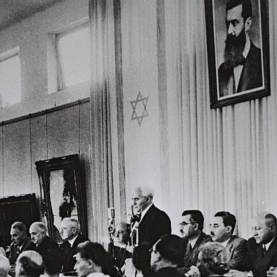
Encountering Israel’s Declaration of Independence
Israel’s Declaration of Independence, formally the Declaration of the Establishment of the State of Israel, is a rich document that enables exploration of core values and aspirations of the founders of the Jewish state in 1948. ...
LEARN MORE